
How Oil And Shedding Are Linked
When the scalp is oily, itchy and shedding at the same time, those things are usually part of one picture.
What Women Usually Describe
However often you wash, and whatever you use, none of this is a verdict on your care. Scalps that behave this way are common, and they respond well once the irritation is identified.
Why An Irritated Scalp Sheds
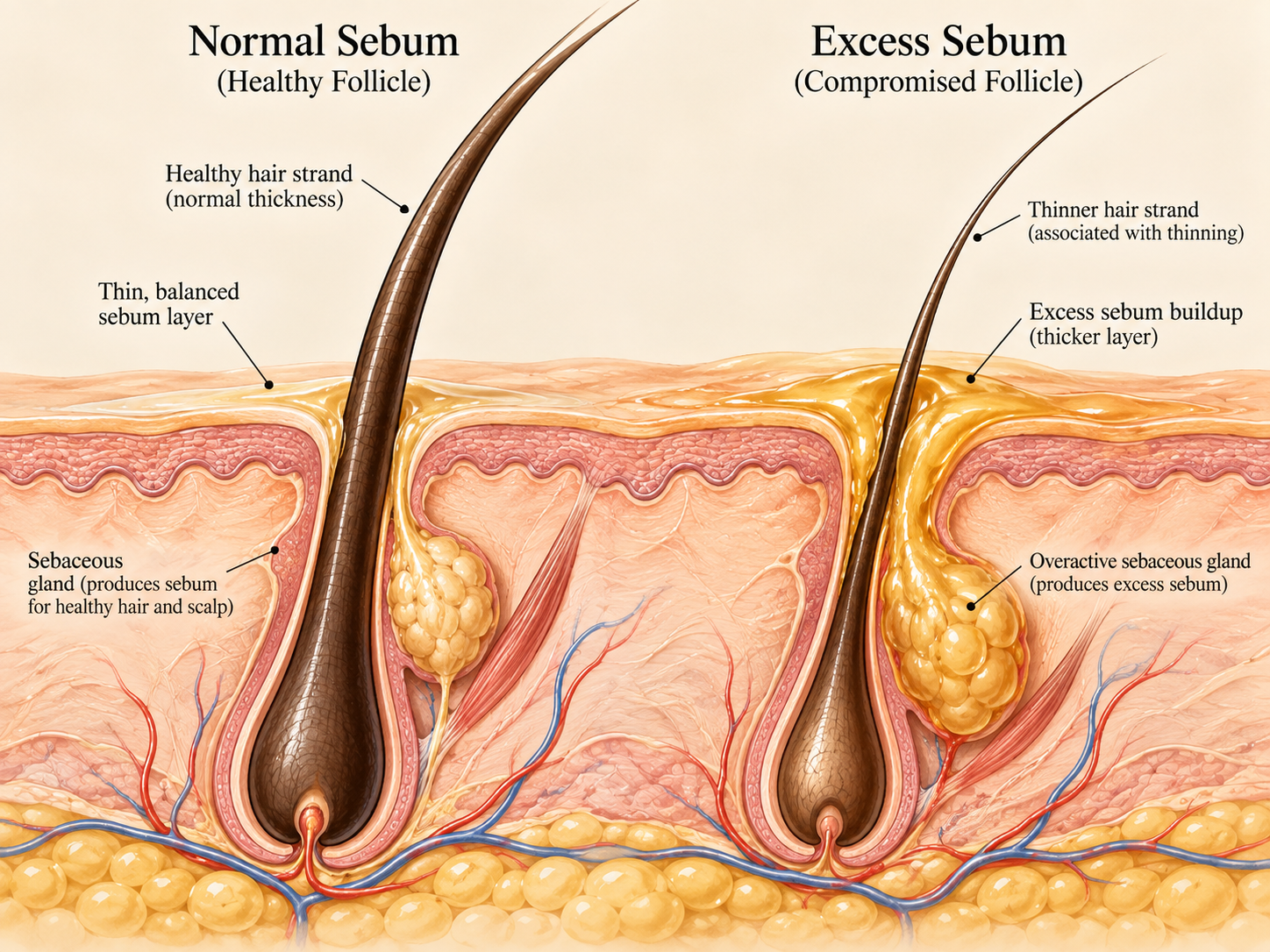
Sebum is protective in normal amounts. In excess it becomes food for the yeast that lives on everyone's skin, and in some people that overgrowth triggers redness, itching and flaking. That is the seborrheic pattern, and the follicles sitting inside it are working in an inflamed environment.
Reading An Oily Scalp At 200x
Inflammation shortens the growing phase. Hairs let go earlier than they should and the replacements come in finer, so density drifts down over months while the shedding feels constant. Where the irritation goes deeper you can get tender bumps and pustules at the openings, which is a different problem needing different care.
Calm The Scalp, Then Match The Growth Plan
Buildup adds a second layer. A collar of sebum and product around the opening blocks contact, so serums, oils and treatments reach a fraction of what they are aimed at. Clearing that is often why a plan that failed before starts working.
Look Before The Next Product Cycle
The order matters. Once the scalp is settled, the growth side of the plan has something to work with, and we can tell whether density is responding rather than guessing.
The cycle we are trying to interrupt

- Oil buildsExcess sebum sits on the scalp and around the follicle.
- Irritation growsRedness, itching, or flaking can become part of the picture.
- The follicle is stressedThe scalp environment becomes less supportive of steady growth.
- Shedding becomes noticeableMore hair appears on wash day while the underlying scalp problem remains.
The answer is not always to wash harder or add another drying product. If the scalp is already irritated, aggressive cleansing can become another source of discomfort without settling the reason oil keeps returning.
What we look for at 200x
Magnification lets us separate what feels similar from the outside. We can document where oil and buildup sit, whether the surface looks inflamed, and whether the thinning is diffuse or concentrated in a pattern that needs a different question.
| What we observe | What it changes about the next step |
|---|---|
| Oil and buildup around follicles | The scalp environment needs direct attention |
| Redness, itching, or flaking | Irritation belongs in the plan, not only the oil |
| Diffuse shedding | The history may point us toward an internal question as well |
| Concentrated thinning | A different hair-loss pattern may be present alongside the oil |
Why your routine needs context
Wash frequency, product texture, protective styles, and how the scalp feels between wash days all matter. The aim is not to judge the routine. It is to understand what the scalp is being asked to manage.
- How soon oil returns after washing
- Whether itching or flaking follows
- Which products sit directly on the scalp
- Whether shedding is all over or concentrated
- What changed before the oil and thinning began together
Your care is not the problem. Oil is a symptom to interpret, not a character flaw and not proof that your scalp is dirty.
Once the source of irritation is clearer, the routine can become calmer and more intentional. A balanced scalp gives the hair a better environment to do its work.
Not sure this is you? See your scalp at 200x.
Book My $99 DiscoveryFrequently asked questions
Can an oily scalp cause hair shedding?
Oil itself does not pull out hair. The connection described here is irritation: excess oil, buildup, redness, itching, and flaking can create a stressed scalp environment that may accompany earlier shedding.
Does an oily scalp mean I am not washing enough?
No. Oil is a symptom to interpret, not proof that the scalp is dirty or that your care is poor. How quickly oil returns, what products sit on the scalp, and whether irritation follows are more useful details.
What can a 200x scalp read show?
Magnification can document oil and buildup around follicles, visible irritation, and whether thinning is diffuse or concentrated. That helps determine whether the scalp environment is central or another hair-loss pattern may be present too.
Should I use a stronger clarifying product?
Not automatically. If the scalp is already irritated, more aggressive cleansing may add discomfort without addressing why the oil keeps returning. The routine should follow what the scalp and history show.

Written and reviewed by
Double Board Certified Trichologist. PhD in Functional Drugless Medicine. Master Cosmetologist. Founder and Clinical Director of Nina Ross Atlanta, with 10 years of specialized care and 2,500+ clients seen.