
Why Hair Loss Hits Black Women So Hard
You are not imagining it. Thinning edges and quietly disappearing crowns run through our community, and the problem is usually not the styling choices. It is the medical care that never looked properly.
You Have Watched It Happen Around You
Aunts, cousins, girlfriends. Edges that thinned and never came back. Parts placed strategically. Edge control doing work it was never meant to do. A wig that has not come off in front of anyone in a long time.
Why This Is Not Your Fault
Many of the women who come to our Atlanta clinic have been told at some point that their hair is simply too difficult, or too fragile, or that this is just how it goes. What was actually missing was care from someone who understood textured hair.
The Three Conditions Stealing Our Hair
So the feeling becomes shame, when the real story is a medical system that was not trained on your hair.
Beyond "Just Go Natural"
Thinning edges and heavy periods belong in the same conversation. So do a family history of thyroid disease and a crown that has been quietly changing for two years. The scalp read and the body work together, or neither one tells you much.
Reading The Whole Picture
Treatment is adjusted for textured hair rather than borrowed from a straight hair protocol. Where they fit, that can include exosome therapy and PRP, with placement and technique chosen for how your follicles actually sit. Where the driver is internal, we treat that alongside the scalp instead of layering on more topicals.
Three patterns that need different plans
| Pattern | What brings women in | Why the distinction matters |
|---|---|---|
| CCCA | Quiet change around the crown that can resemble ordinary thinning | Inflammation and the risk of scarring change the urgency |
| Traction alopecia | Edges or stressed areas connected to a long styling history | The plan has to account for how the hair is actually worn |
| Hormonal loss | A wider part or loss of volume alongside a larger body change | The scalp and internal picture need to be read together |
These patterns can overlap. That is why naming hair loss as a single community-wide problem is not enough. The useful work begins when we identify which pattern is happening for the woman in front of us.
What culturally competent care changes
Textured hair is not a complication to work around. Styling history, wash routines, protective styles, chemical services, and the way inflammation appears on melanated skin all belong in the conversation without judgment.
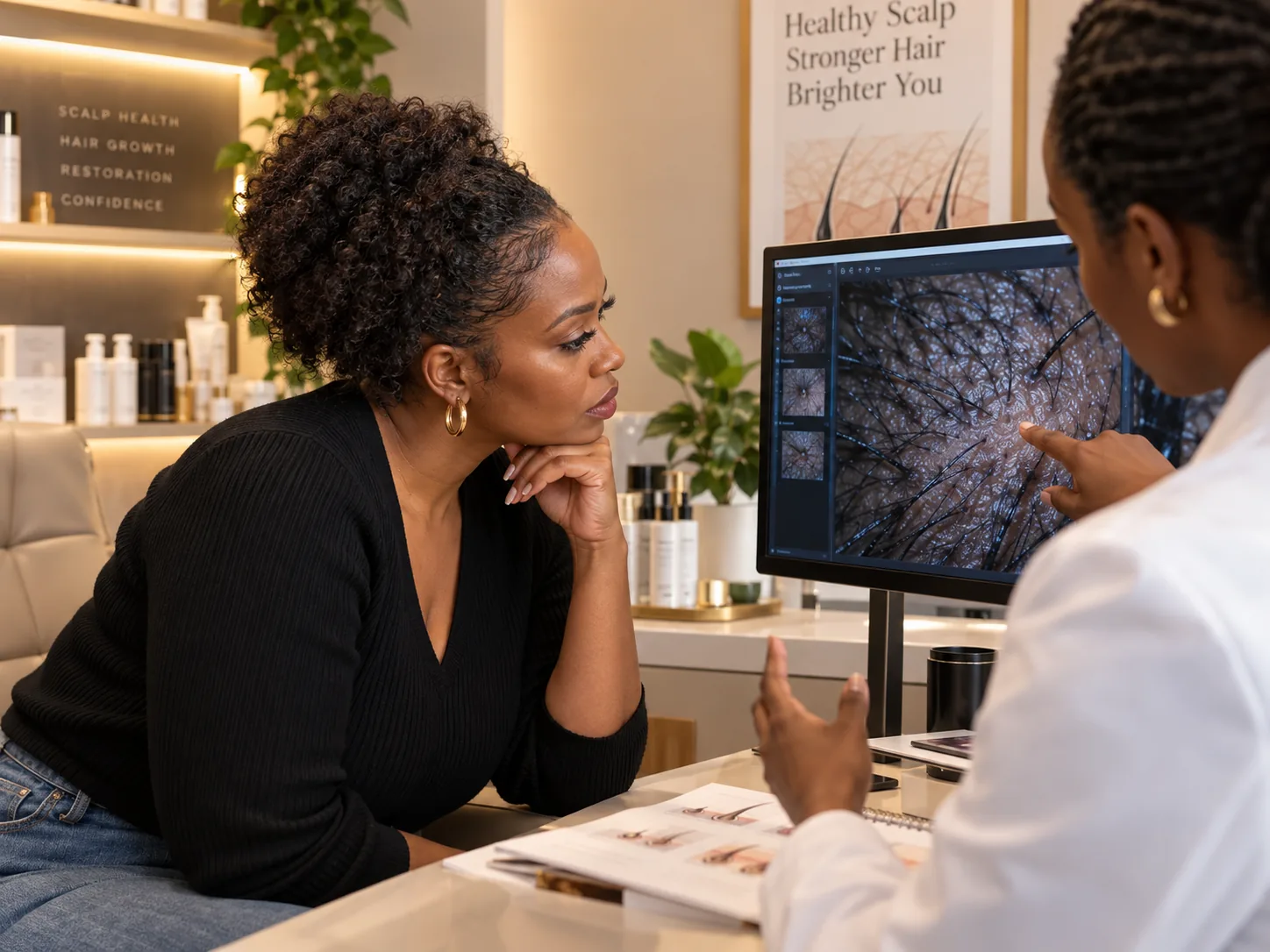
That context changes the quality of the questions. Instead of assuming the style caused everything, we can ask whether the location, timing, and scalp surface agree with traction, CCCA, an internal driver, or a mixed picture.
How we read the whole picture
- Map where density has changed
- Look closely at the crown, part, hairline, and edges
- Ask how the area feels, not only how it looks
- Connect the timeline to styling and whole-body changes
- Choose scalp care, internal evaluation, or both based on what agrees
Care starts with being believed. You should not have to prove that your hair loss matters before someone looks closely.
A precise name for the pattern can replace years of self-blame with a plan. That is the hopeful shift: your hair is not too difficult, and your questions are worth answering properly.
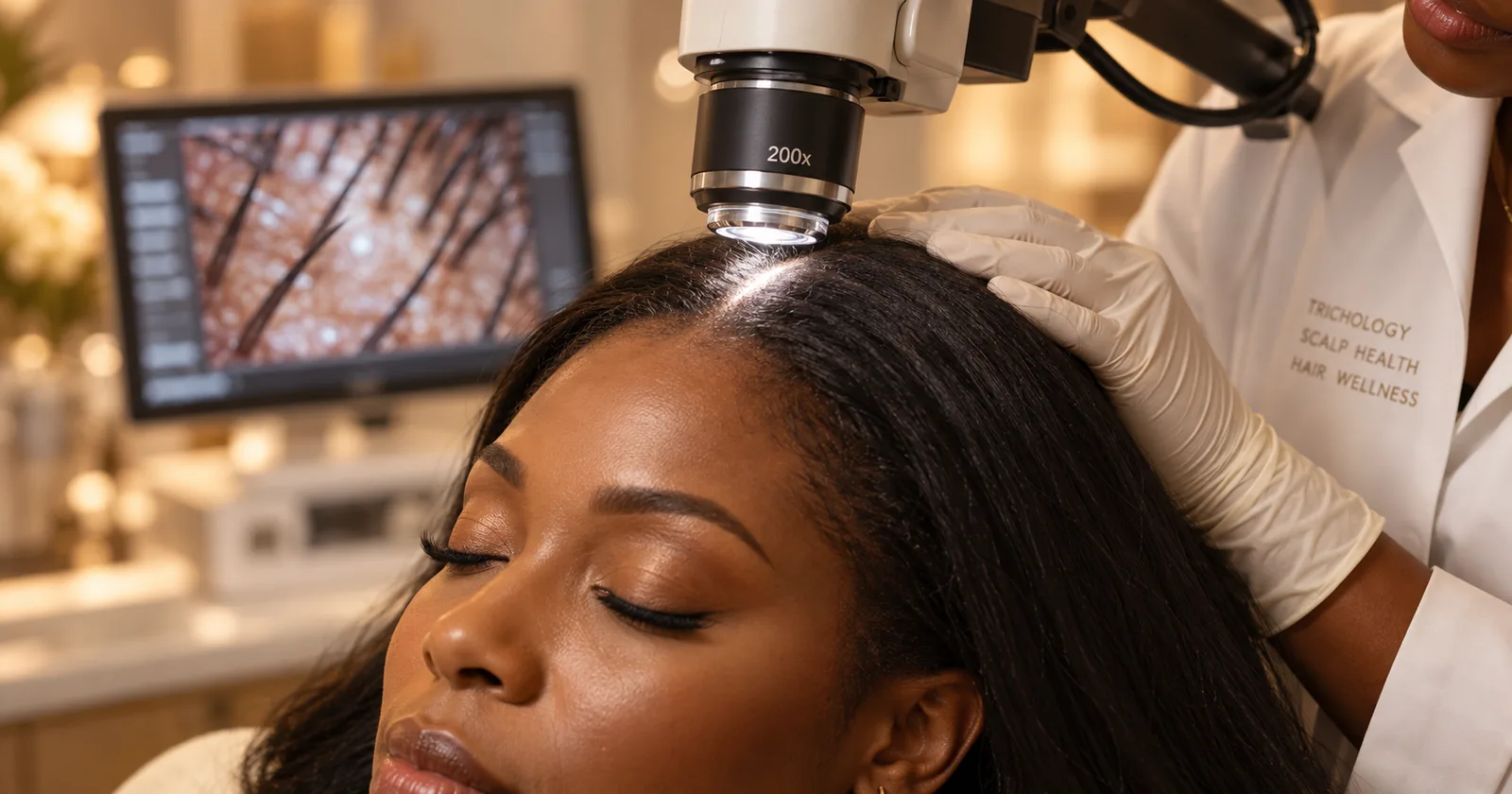
Not sure this is you? See your scalp at 200x.
Book My $99 DiscoveryFrequently asked questions
Why is hair loss often missed in Black women?
The article identifies a care gap: textured hair, melanated skin, and conditions such as early CCCA and traction alopecia are not always read closely. When the pattern is treated as cosmetic or blamed only on styling, important distinctions can be overlooked.
What three patterns should be considered?
CCCA, traction alopecia, and hormonal loss are three patterns discussed here. They can overlap, but they do not call for the same response. The crown, edges, part, scalp surface, styling history, and whole-body timeline help separate them.
Is protective styling always the cause?
No. Styling history belongs in the conversation, but it should not replace a complete evaluation. Thinning edges, crown changes, inflammation, heavy cycles, thyroid history, and other body changes may point to different or overlapping questions.
What does culturally competent hair care include?
It includes understanding textured hair, discussing styling without judgment, recognizing how scalp changes can appear on melanated skin, and choosing care for the actual pattern rather than borrowing a generic protocol.

Written and reviewed by
Double Board Certified Trichologist. PhD in Functional Drugless Medicine. Master Cosmetologist. Founder and Clinical Director of Nina Ross Atlanta, with 10 years of specialized care and 2,500+ clients seen.