PRP Therapy
Growth signals placed into the scalp to wake follicles that are still viable.
Home / Conditions / Scarring / CCCA
Scarring · condition 01 of 18
Central centrifugal cicatricial alopecia. Starts at the crown and spreads outward, quietly.
 Clinically reviewed by Dr. Nina Ross, NDServing all of Metro Atlanta
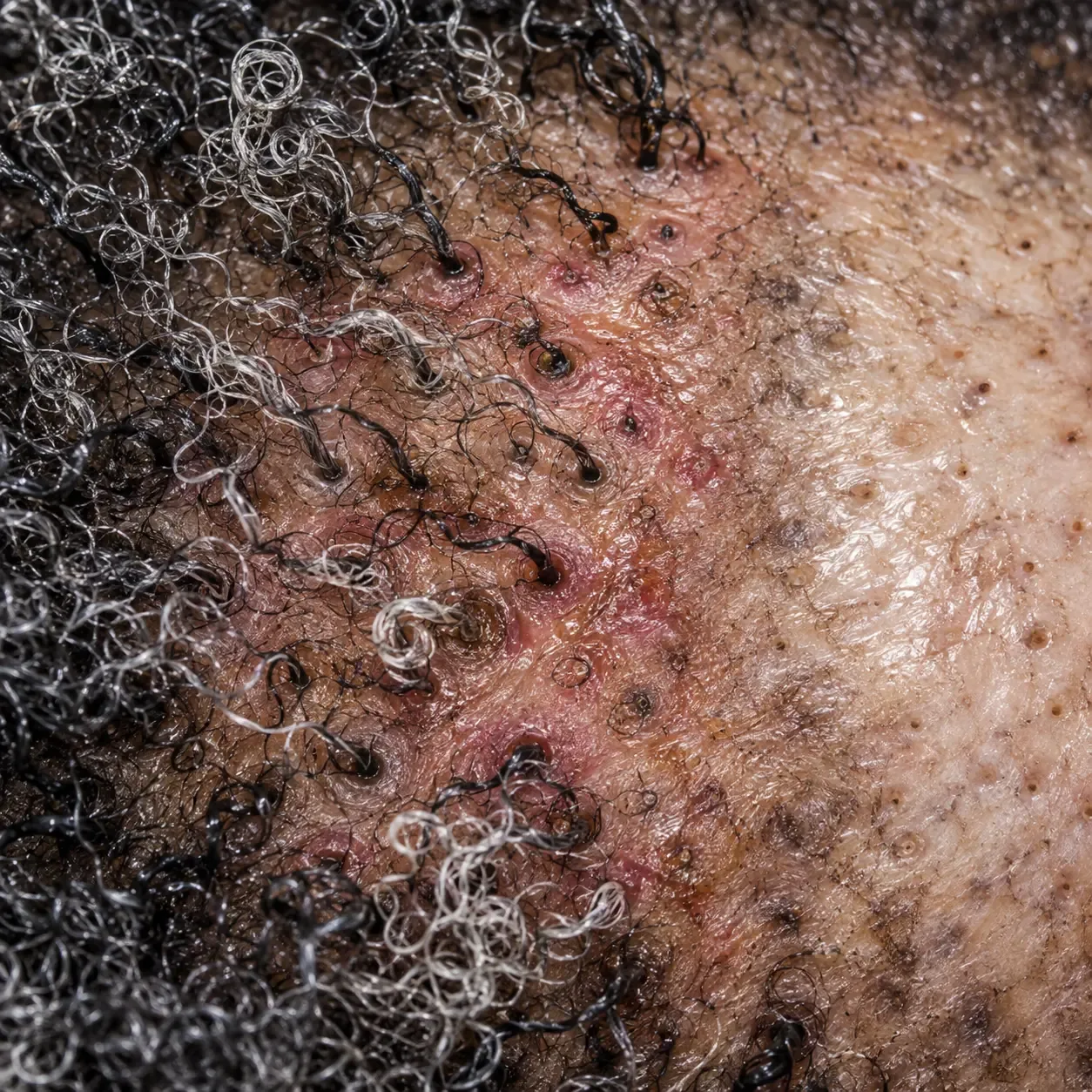
Central centrifugal cicatricial alopecia, or CCCA, is a scarring hair loss that begins at the crown and moves outward in a circular pattern.
In the early stage the scalp often looks shiny or feels tender, and the hair at the center breaks or thins before any bald patch appears.
Because it is scarring, follicles that have already been replaced by scar tissue will not grow hair again. Follicles at the active border frequently can be saved when the inflammation is calmed early. At Nina Ross Atlanta in Sandy Springs, we read the crown at 200x magnification to separate scarred areas from areas that still have living follicles, then treat the active edge. Serving all of Metro Atlanta.
What you might be noticing
Tap the one that sounds like you to see why it happens and how we figure it out.
My crown feels tender or itchyScalp tenderness, pruritus, burning✋🏾
Tenderness, itch or burning at the crown is commonly linked to inflammation around the upper follicle, the process behind CCCA. It often shows up before thinning is obvious.
We read the tender area at 200x for white halos and inflamed openings, so the spot you feel gets read even when it looks fine in the mirror.
The center of my part looks shinyLoss of follicular openings, atrophic shine✋🏾
Shine at the center is commonly linked to follicular openings being replaced by smoother tissue. The surface reflects light because the openings are gone.
Magnification shows exactly where openings are still present. Where they are gone we tell you plainly, and we map the living follicles around them.
My crown keeps breaking offHair shaft fragility over the vertex✋🏾
Breakage concentrated at the crown is commonly linked to early CCCA, when hairs at the center weaken before a patch appears. It can also be ordinary breakage.
We read the hair shafts and the follicles underneath at 200x to tell breakage from early CCCA, because the two need different care.
The thin spot is getting widerCentrifugal spread from the vertex✋🏾
CCCA typically moves outward from the crown in a circle. A spot that keeps widening suggests the border is still active.
We photograph the border at the same points every visit, so you can see whether it is still moving or has stopped.
My hair will not hold a style thereReduced density and caliber at the crown✋🏾
When a style will not hold at the crown, it is commonly because there are fewer hairs there and the ones left are finer.
We compare density and hair thickness at the crown with an unaffected area, which shows how much is thinning and how much is scarring.
What causes it
CCCA is driven by chronic inflammation at the upper follicle. Over time that inflammation replaces the follicular structure with fibrous tissue, which is why the surface starts to look smooth.
CCCA is reported to run in families, and research has looked at gene variants involved in hair shaft formation. A family history at the crown is worth telling us about.
Certain grooming practices have been associated with CCCA in some studies, although CCCA is multifactorial and these practices have not been established as the sole cause.
Associations have been described with conditions such as type 2 diabetes and thyroid disease. This is one reason your visit looks at more than the scalp surface.
More detail
CCCA is reported far more often in Black women than in any other group. Research points to a mix of factors: inflammation at the upper follicle, familial patterns, gene variants involved in how the hair shaft forms, and associated metabolic conditions.1
Certain grooming practices have been associated with CCCA in some studies, although CCCA is multifactorial and these practices have not been established as the sole cause.
What that means for you in practice: styling is one part of the conversation. We look at the scalp, the pattern and the systems behind it before anyone tells you what caused this.
What we see that others miss
A biopsy tells you what the tissue looks like at one small point. Trichoscopy at 200x tells you what the whole crown is doing right now, and you watch it on screen with us.
What we look for: peripilar white halos around the follicle, loss of follicular openings in the center, and a border where openings are still present but inflamed. That border is the part of your scalp still worth fighting for.
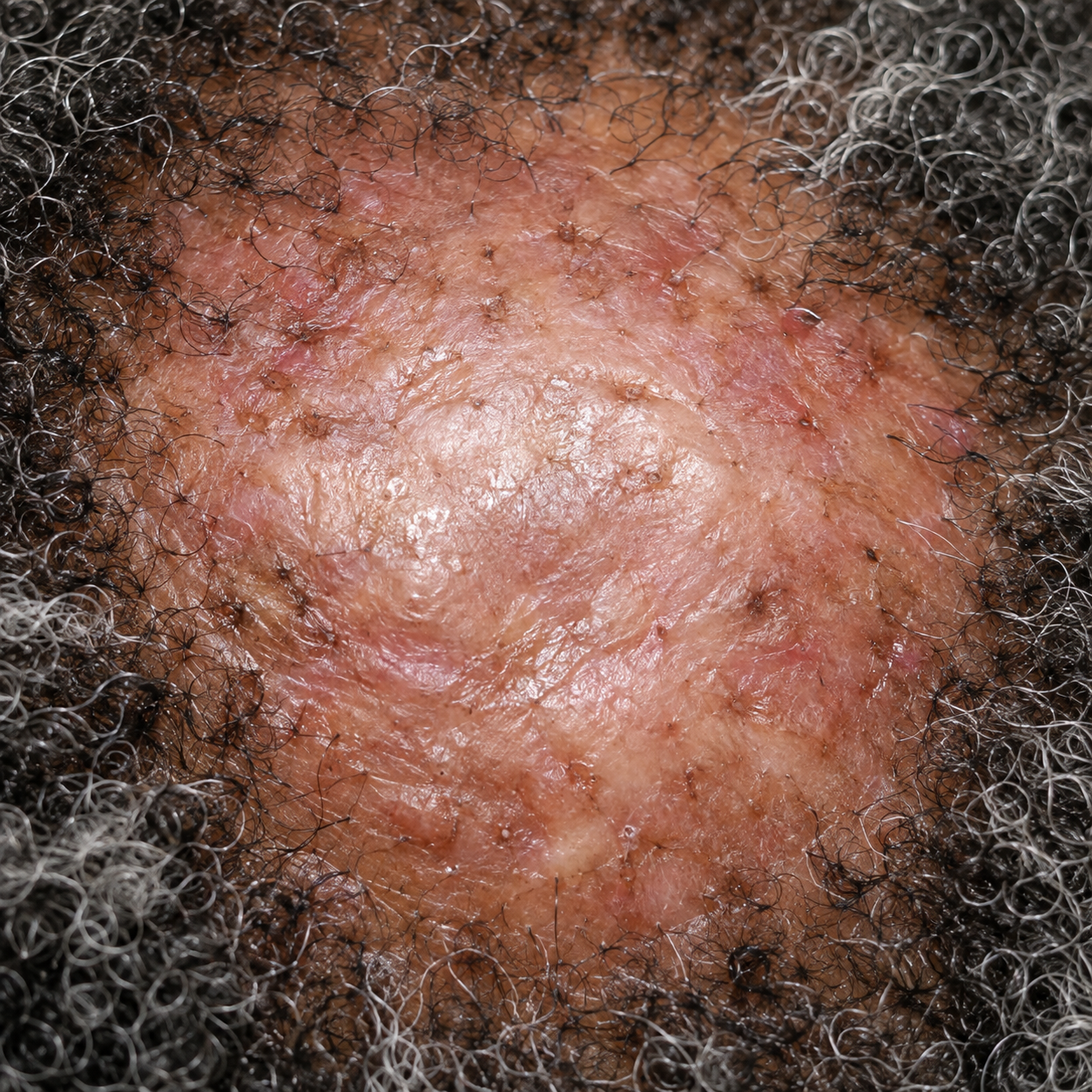
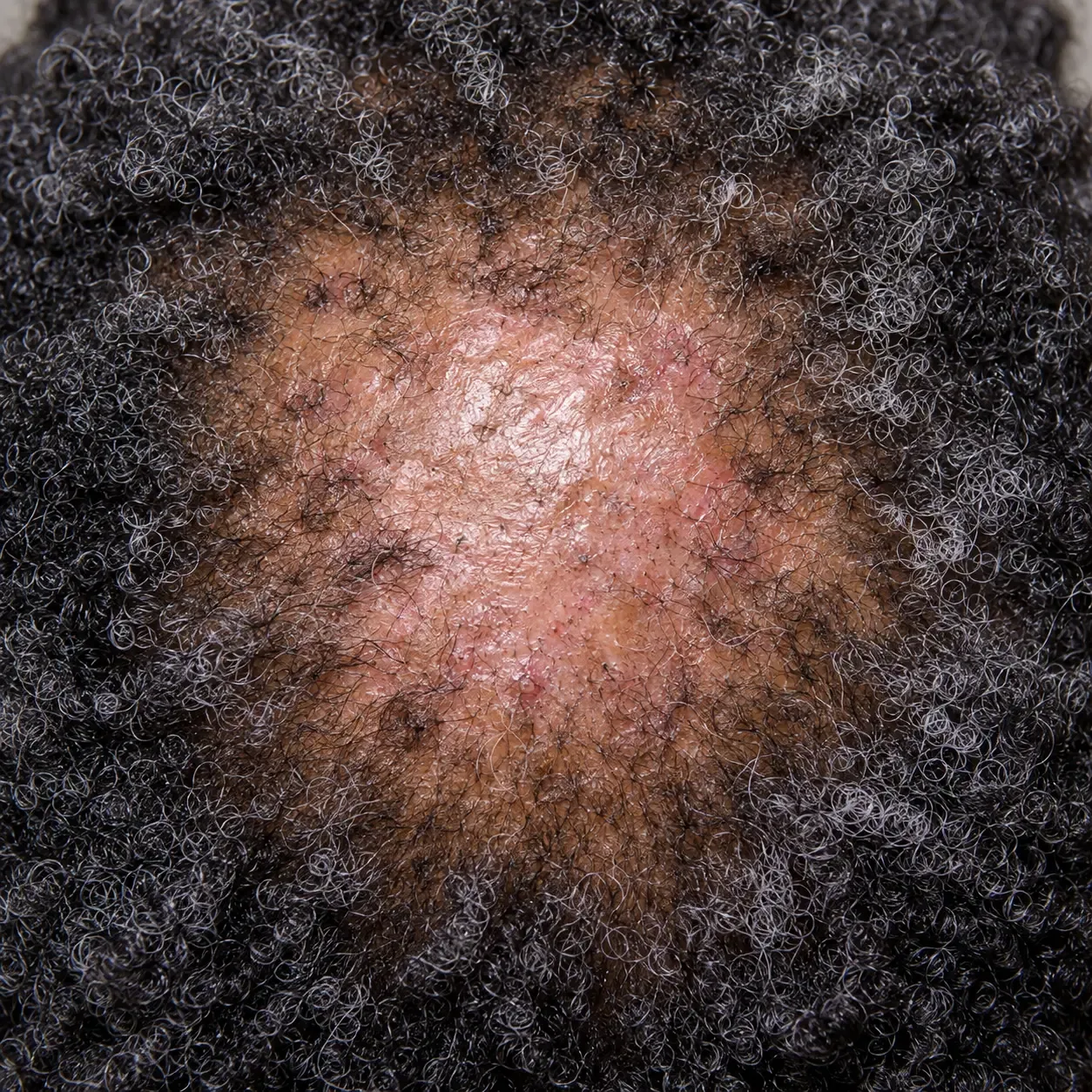
We photograph the same points every visit, so change is measured rather than guessed at.
How we treat it
We start by mapping the crown at 200x so you can see the difference between scarred zones and the active border. Care focuses on calming the inflammation at that border first, then supporting the follicles that are still producing. Where the center has scarred, we are honest with you: that area will not regrow, and the work is holding the line around it. Everything is handled in-house.
Growth signals placed into the scalp to wake follicles that are still viable.
Low level light used to calm scalp inflammation and support the growth phase.
A structured in-house program that treats the scalp and the systems behind it.
One visit. Real answers.
Our promiseYou'll leave actually seeing what's happening, your scalp at 200x, the systems behind it, with your report the next day. If you don't, the $99 is on us.
Fully HSA/FSA eligible. 0% financing for qualified applicants.
You are welcome here
CCCA is diagnosed most often in Black women, and too many people are told it is just a styling problem and sent away. Your hair history, relaxers, braids, locs, weaves and heat included, is clinical information here, never a verdict on you.
Relaxers, braids, locs, weaves and heat. Share your full hair history. It is welcomed, never judged.
10 years of specialized care2,500+ clients seenNo judgment
Related conditions
An inflammatory scarring alopecia that often burns or stings before it shows.
Tension-driven loss at the edges and part lines. Often reversible early.
Tender, sometimes pus-filled bumps sitting right on the follicle.
Questions, answered
Scarred follicles do not regrow. That is the honest answer. What can change is the border, where follicles are inflamed but still alive. When we calm that inflammation early, we are protecting hair you still have and giving the compromised edge a chance to fill back in. Results not typical. Individual results will vary.
At 200x, CCCA shows white halos around the follicle and a smooth center where openings are gone, starting at the crown. Traction alopecia sits at the edges and part lines, and lichen planopilaris shows scale wrapped around individual hairs in irregular patches.
A biopsy shows the tissue at one small point. Trichoscopy at 200x shows what the whole crown is doing right now, on screen while you watch. We tell you plainly what the read shows and what it means for next steps.
Your styles are part of the conversation, never a verdict. Certain grooming practices have been associated with CCCA in some studies, although CCCA is multifactorial and these practices have not been established as the sole cause. We build around the hair you want to wear.
As soon as you notice tenderness, shine or a spot that keeps widening at the crown. Early is when the active border is widest, and that border is the part we can still protect.
Results not typical. Individual results will vary.
You'll see it, or the $99 is on us. Serving all of Metro Atlanta.
Nina Ross Atlanta, 8735 Dunwoody Place, Suite 290, Sandy Springs, GA 30350. Monday to Saturday, 10:00 AM to 3:30 PM.