 08
08
Alopecia Areata
Smooth, round patches that appear quickly. The follicle usually survives.
Home / Treatments / Light therapy / Red Light Therapy
Light therapy · treatment 08 of 8
Knowing whether it is worth your time.
 Clinically reviewed by Dr. Nina Ross, NDServing all of Metro Atlanta
Red light therapy, also called low-level light therapy, uses red and near-infrared wavelengths at low power to support activity in follicles that are still alive and to calm inflammation in the scalp around them.
Randomized trials in pattern hair loss have shown modest increases in hair counts against sham devices, which is why it is an accepted adjunct rather than a primary treatment.1 It does not diagnose anything, it does not reverse scarring, and it does not address a hormonal, thyroid or nutrient driver that is still running.
At Nina Ross Atlanta in Sandy Springs, serving all of Metro Atlanta, whether red light belongs in your plan is decided from what your scalp shows at 200x magnification and your systems review, and it is usually paired with other work. Certified trichologists perform every hands-on treatment and Dr. Nina Ross, ND oversees protocols as Clinical Director.
What it does for you
Where the scalp is inflamed, tender or reactive, that environment works against everything else you are doing. Low-level light is one of the gentler ways to settle it.
Light supports activity in follicles that are still producing, including miniaturizing ones. It cannot restart a follicle that has closed, and your images show which are which.
If light is a reasonable part of your plan, we say where it fits. If your presentation needs a different first step, we say that instead and save you the months.
Red and near-infrared wavelengths at low power are absorbed at the follicle level, supporting cellular activity and reducing local inflammation. It supports. The cause still needs addressing.
How it works
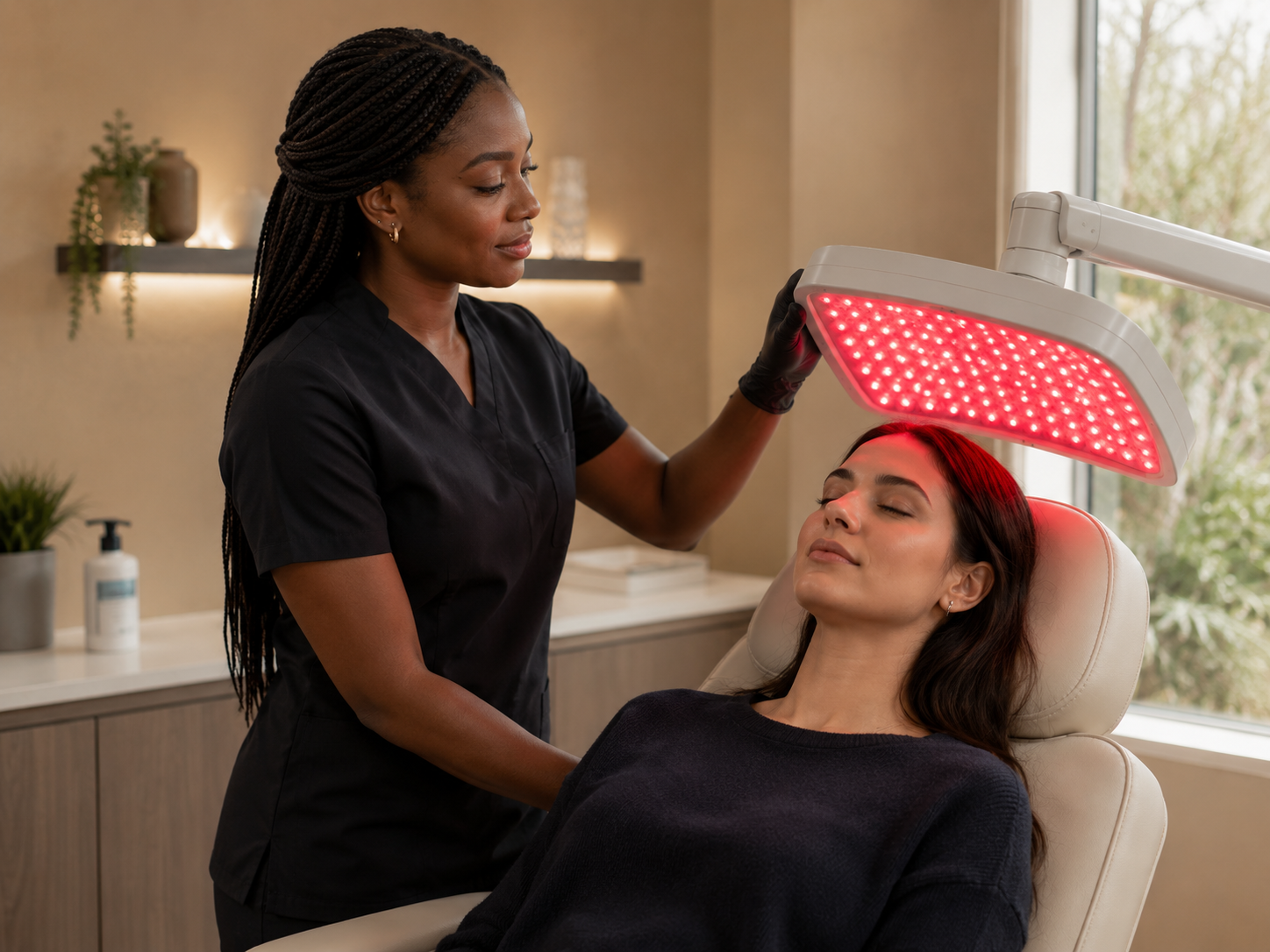
You sit under a panel or hood at a set distance so the treated areas receive even exposure. Hair is parted or sectioned so the light reaches skin.
Quiet and undramatic. Mild warmth and nothing sharp. Most people read or close their eyes for the exposure time, then carry on with their day.
Sessions run for a set exposure time on a set rhythm, because light works through consistency across the growth cycle. Your rhythm is given to you in writing.
Inside Restorative Therapy, light sits alongside growth factors, microchanneling and targeted supplementation. As a standalone it is generally used where inflammation is the main thing to settle.
New magnified images from the same positions are compared against your baseline. If they are not changing, we say so and change the plan.
Certified trichologists perform all hands-on treatments. Dr. Nina Ross, ND oversees the protocols as Clinical Director. Everything is handled in-house.
What we see that others miss
Red light is one of the most oversold devices in hair loss and one of the more useful supporting tools, depending entirely on what is wrong.
It helps most where inflammation is part of the picture: alopecia areata, the calmer edges of lichen planopilaris, scalps flaring with seborrheic dermatitis or folliculitis. Light is gentle enough for a scalp that will not tolerate much, and settling that environment often lets the rest of the protocol start working.
It helps as an adjunct after a procedure. Following microchanneling, growth factor work or PRP, light supports the recovering scalp while the follicle responds to what was just delivered. And it helps where a scalp needs support but cannot take an intervention yet.
It does very little alone in three situations. Where the driver is systemic, such as thyroid, iron, a hormonal shift or a nutrient shortfall. Where follicle openings are already scarred and closed. And where tension is still being applied every day.
The pattern we see in the chair is people who used a cap faithfully for six to twelve months and arrive with images that look the same, because nobody told them what was driving their loss. The device was fine. Using it in place of a diagnosis was the problem.
What to expect
Whether light belongs in your plan is decided from your Hair & Body Discovery, with your scalp read at 200x on screen and your written report the next day.
We tell you plainly whether light is a supporting part of your plan, the main thing while a scalp calms, or not worth your money in your case.
Standardized magnified images are captured from set positions so every later review compares against the same starting point.
You are positioned under the panel at a set distance for a set exposure time, then carry on with your day.
Sessions repeat on a set rhythm because consistency across the growth cycle is where any effect comes from. You get the spacing in writing.
Where light is one part of a program, the other parts run alongside it, and the whole-body side is handled in-house at the same time.
New images from the same positions are compared against baseline at 200x, and they decide whether we continue, adjust or stop.
What is realistic
Light works through the growth cycle and through repetition, so nothing is visible early. The first weeks look like nothing, and that is expected.
Where a scalp was inflamed, comfort usually settles first: less itching, less tenderness, less flaring. That is often the first honest change people notice.
Any density change comes later and is modest. Where light is part of a broader protocol, what you see is the protocol working together. Where follicles have scarred, those areas do not regrow, with light or without it, and we show you where that line falls before you start.
Results not typical. Individual results will vary.
Ideal for
Smooth, round patches that appear quickly. The follicle usually survives.
Central centrifugal cicatricial alopecia. Starts at the crown and spreads outward, quietly.
An inflammatory scarring alopecia that often burns or stings before it shows.
Greasy flaking and itch that keep the scalp inflamed.
Tender, sometimes pus-filled bumps sitting right on the follicle.
Rapid loss during treatment. The follicles usually survive.
Honest screening
Anyone expecting light alone to reverse advanced scarring. Where follicle openings have closed, there is nothing left to stimulate.
Anyone whose presentation needs a different first step. A systemic driver, an active infection or ongoing tension gets addressed first.
Anyone treating it as a substitute for diagnosis. Buying a device before knowing what is wrong is the most common way people lose a year.
Anyone photosensitive or taking medication that increases light sensitivity. Tell us what you are taking and we assess it before booking anything.
Safe for textured hair
Light has to reach the scalp, so sectioning and positioning are planned around dense, coiled or protective-styled hair. We part and position so the treated zones are actually exposed, and plan around braids, locs and weaves.
Where there is buildup, irritation or scaling, light is paired with deep cleansing or other calming steps first, so we are treating skin. Relaxers, braids, locs, weaves and heat. Share your full history. It is welcomed, never judged.
One visit. Real answers.
Our promiseYou'll leave actually seeing what's happening, your scalp at 200x, the systems behind it, with your report the next day. If you don't, the $99 is on us.
Fully HSA/FSA eligible. 0% financing for qualified applicants.
Hands-on treatments are performed by certified trichologists, with clinical direction from Dr. Nina Ross, ND, Double Board Certified Trichologist. Everything is handled in-house.
10 years of specialized care · 2,500+ clients seen · All care in-house
Questions, answered
Modestly, in the right situation. Randomized trials in pattern hair loss have shown small increases in hair counts against sham devices, which is real but limited. It earns its place as part of a protocol where inflammation needs settling or where it supports other treatment, and we tell you honestly which applies to you.
Sessions follow a set rhythm based on your findings, because consistency is where any effect comes from. You get the spacing in writing before you start.
You can, and many people do. The risk is using it for months without knowing what is driving your loss. Find out first, then decide where light fits.
Often, yes. Light supports the recovering scalp after PRP and is one of the five tools inside Restorative Therapy.
It shows whether inflammation is part of your picture, whether follicles are still producing, and whether an internal driver needs addressing first. Those answers decide where light fits, if at all.
Before you spend months on light alone, it is worth finding out whether it belongs in your plan at all. The first step is seeing what your scalp is actually doing, and leaving with that in writing. Serving all of Metro Atlanta.
Nina Ross Atlanta, 8735 Dunwoody Place, Suite 290, Sandy Springs, GA 30350. Monday to Saturday, 10:00 AM to 3:30 PM.