 05
05
Traction Alopecia
Tension-driven loss at the edges and part lines. Often reversible early.
Home / Treatments / Regenerative / Microneedling
Regenerative · treatment 05 of 8
Getting more out of everything else you are already doing.
 Clinically reviewed by Dr. Nina Ross, NDServing all of Metro Atlanta
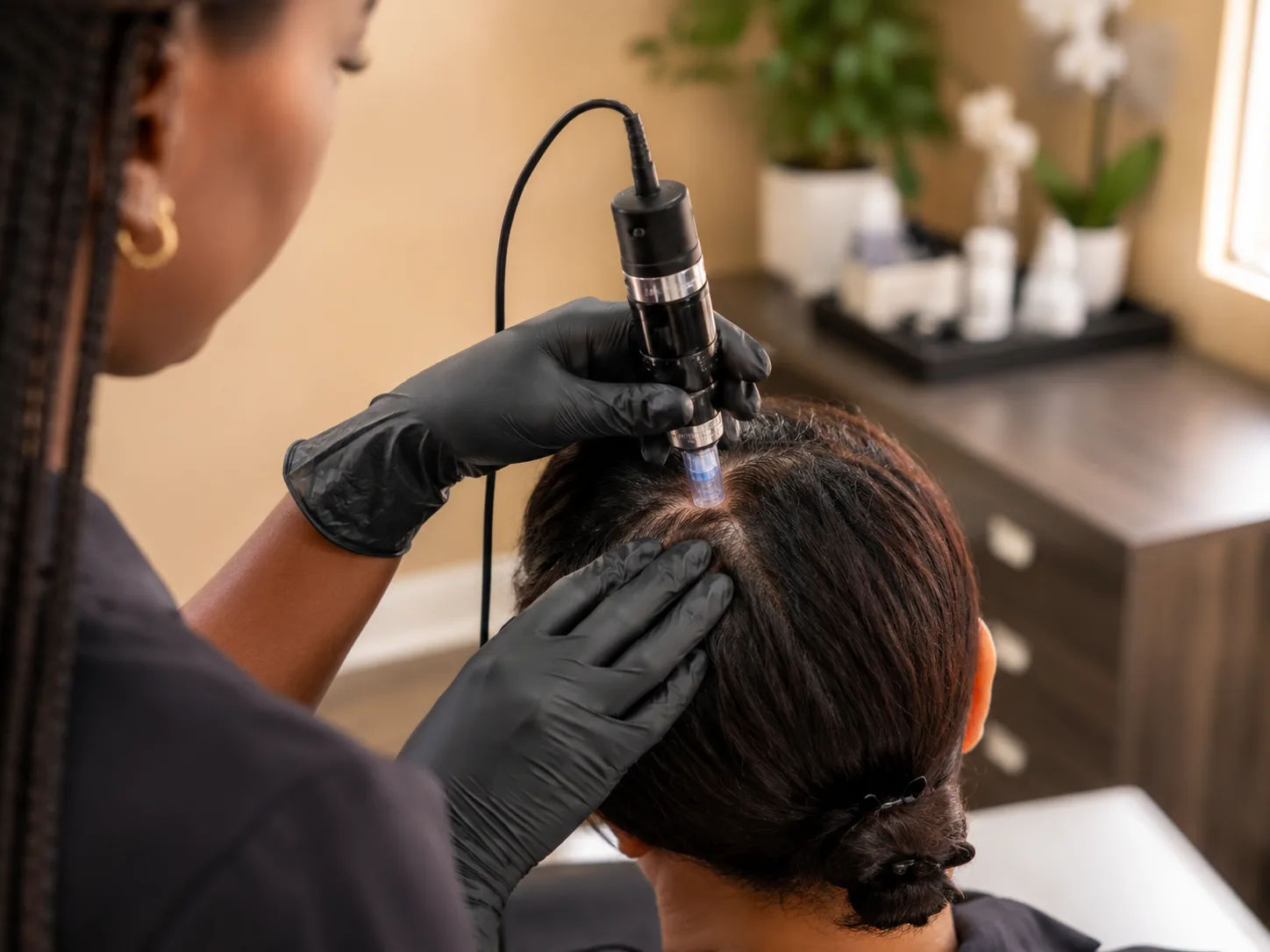
Scalp microneedling for hair uses fine needles at a controlled depth to create precise micro-injury in the scalp. The body responds with its normal repair process, which brings growth signaling and blood flow to the treated area.
The same channels also let topicals and paired therapies such as PRP or growth factors move past the skin surface.
Most people describe the session as pressure with brief stinging in thinner areas, and the scalp usually looks pink and feels warm for a short period afterward. Sessions are spaced so the scalp fully settles in between. Candidacy, depth and spacing are decided from what trichoscopy at 200x shows about follicle viability, inflammation and scarring. At Nina Ross Atlanta in Sandy Springs, serving all of Metro Atlanta, certified trichologists perform every session.
What it does for you
If a topical is only partly absorbing, some of what you are paying for never reaches the follicle. Microneedling opens temporary channels so more of what you apply goes where it is meant to go.
Paired with PRP or growth factors in the same visit, the delivery route is already open. That pairing is the main reason we use microneedling here.
Controlled micro-injury calls the body's own repair response into the treated area. Where follicles are miniaturized but alive, that support can matter. Where they are gone, it cannot bring them back.
Depth and spacing come from your 200x read, which keeps the treatment useful on thin edges and cautious near scarred margins.
Microneedling is an amplifier. It is used alongside PRP, growth factor therapy and the Restorative Therapy program, and it is not offered as a standalone answer to hair loss.
How it works
Before any needle touches the scalp, the treatment area is mapped against your magnified images. Active areas, thin edges and any scarred or previously inflamed margins are marked so they are treated differently or avoided.
Depth is set by region. Skin thickness, tension history and how close an area sits to a scarred margin all change the setting, so one scalp can call for more than one depth in a visit.
Your trichologist works in a consistent pattern across each mapped zone. Pinpoint bleeding in some areas is an expected part of the process.
The scalp is cleaned and any paired serum, PRP or growth factor preparation is applied while the channels are open. You leave with instructions on what to avoid and for how long.
Where PRP or growth factors are part of your plan, microneedling is scheduled in the same visit so the delivery is combined.
Certified trichologists perform all hands-on treatments. Dr. Nina Ross, ND oversees the protocols as Clinical Director. Everything is handled in-house.
What we see that others miss
Most microneedling guidance assumes a straight scalp with an even skin surface and no history of tension. Textured hair changes several of those assumptions at once, and the settings have to change with them.
Along a traction edge, the skin is often thinner and has been under repeated pull for years. Depth that suits the crown can be too much at the hairline, so those areas get reduced depth, wider spacing and fewer passes. Going deeper there tends to inflame skin that is already sensitized.
Near CCCA margins the decision is different again. The center of a scarred patch has no follicles left to support. The area of interest is the transitional border where miniaturized follicles are still present, treated conservatively and only once inflammation has settled.
Spacing between sessions is also read from the scalp. If magnified images at the next visit still show redness or irritation from the previous session, the interval was too short for that scalp and it gets lengthened.
Aggressive settings fail in three recognizable places: thinned traction edges, skin still inflamed from folliculitis or seborrheic dermatitis, and fully scarred zones. In each case the answer is a lower depth, a longer interval, or leaving that zone alone until something else is addressed.
What to expect
Your scalp is read at 200x. That read shows whether follicles in the areas that concern you are still viable, whether inflammation needs calming first, and where scarring rules an area out.
If microneedling belongs in your protocol, the zones, depths and any pairing with PRP or growth factors are written down before the first treatment visit.
The scalp is cleaned and prepared, the mapped passes are performed, and any paired preparation is applied straight afterward.
Expect pinkness and warmth, and in some areas small points of dried blood. Your trichologist tells you what to keep off the scalp and when it is safe to wash and restyle.
Sessions are spaced so the scalp is fully settled before the next one, based on how your scalp responded.
Magnified images from the same positions are compared against your baseline to decide whether to continue, change depth or stop.
What is realistic
Microneedling supports a plan. When people see change from it, that change usually shows up as the paired therapy working better than it was before.
The first thing that tends to shift is scalp condition and how topicals feel going on. Changes visible in magnified images take longer, because a follicle cycle takes months.
Advanced scarring alopecia does not reverse with microneedling. In those cases the honest goal is protecting the follicles at the border that are still alive.
Results not typical. Individual results will vary.
Ideal for
Tension-driven loss at the edges and part lines. Often reversible early.
The widening part and the thinner ponytail, explained honestly.
Predictable pattern, variable speed. The earlier you read it, the more you keep.
We treat the scalp. No judgment, no behavioral advice.
Honest screening
Anyone with active infection or uncontrolled inflammation on the scalp. Micro-injury makes it worse, so that has to be calmed first.
Fully scarred zones with no viable follicles. There is nothing left in that tissue to signal.
Anyone expecting microneedling on its own to reverse advanced scarring alopecia. We would rather say that now than take your money for a series.
Anyone with a bleeding disorder or on medication affecting clotting, without clearance from the prescribing clinician first.
Safe for textured hair
On microneedling, safe for textured hair changes the depth at the edges, the spacing between passes, and how close we are willing to work to a scarred margin. A hairline that has carried braids, sew-ins or locs for years behaves differently under a needle, so those areas get lower depth and less frequent treatment.
Aftercare works with how you actually care for your hair, with guidance you can follow with a protective style in place. Relaxers, braids, locs, weaves and heat. Share your full history. It is welcomed, never judged.
One visit. Real answers.
Our promiseYou'll leave actually seeing what's happening, your scalp at 200x, the systems behind it, with your report the next day. If you don't, the $99 is on us.
Fully HSA/FSA eligible. 0% financing for qualified applicants.
Hands-on treatments are performed by certified trichologists, with clinical direction from Dr. Nina Ross, ND, Double Board Certified Trichologist. Everything is handled in-house.
10 years of specialized care · 2,500+ clients seen · All care in-house
Questions, answered
Most people describe it as firm pressure with brief stinging in thinner areas, especially along the hairline. Depth is adjusted by region partly for that reason. Tell your trichologist during the session if an area is uncomfortable, because the setting can be changed while you are in the chair.
Usually little. Expect pinkness and warmth for a short period, and follow the aftercare on when to wash and restyle.
Yes, and that pairing is the main reason we use it. The channels are open when the PRP or growth factor preparation goes on.
Depth, spacing and mapping. We set depth by region from your 200x read and avoid zones that are inflamed or scarred, which a one-setting home roller cannot do.
It shows follicle viability, inflammation and scarring at 200x. Those findings decide whether microneedling belongs in your plan, and where and how deep it is safe to use.
Before you buy another device or add another product, the smaller first step is finding out whether microneedling belongs in your protocol at all, and where on your scalp it would be safe to use. You leave with that in writing either way. Serving all of Metro Atlanta.
Nina Ross Atlanta, 8735 Dunwoody Place, Suite 290, Sandy Springs, GA 30350. Monday to Saturday, 10:00 AM to 3:30 PM.