 02
02
Alopecia Areata
Smooth, round patches that appear quickly. The follicle usually survives.
Home / Treatments / Regenerative / PRP Therapy
Regenerative · treatment 02 of 8
Knowing whether your follicles can still respond.
 Clinically reviewed by Dr. Nina Ross, NDServing all of Metro Atlanta
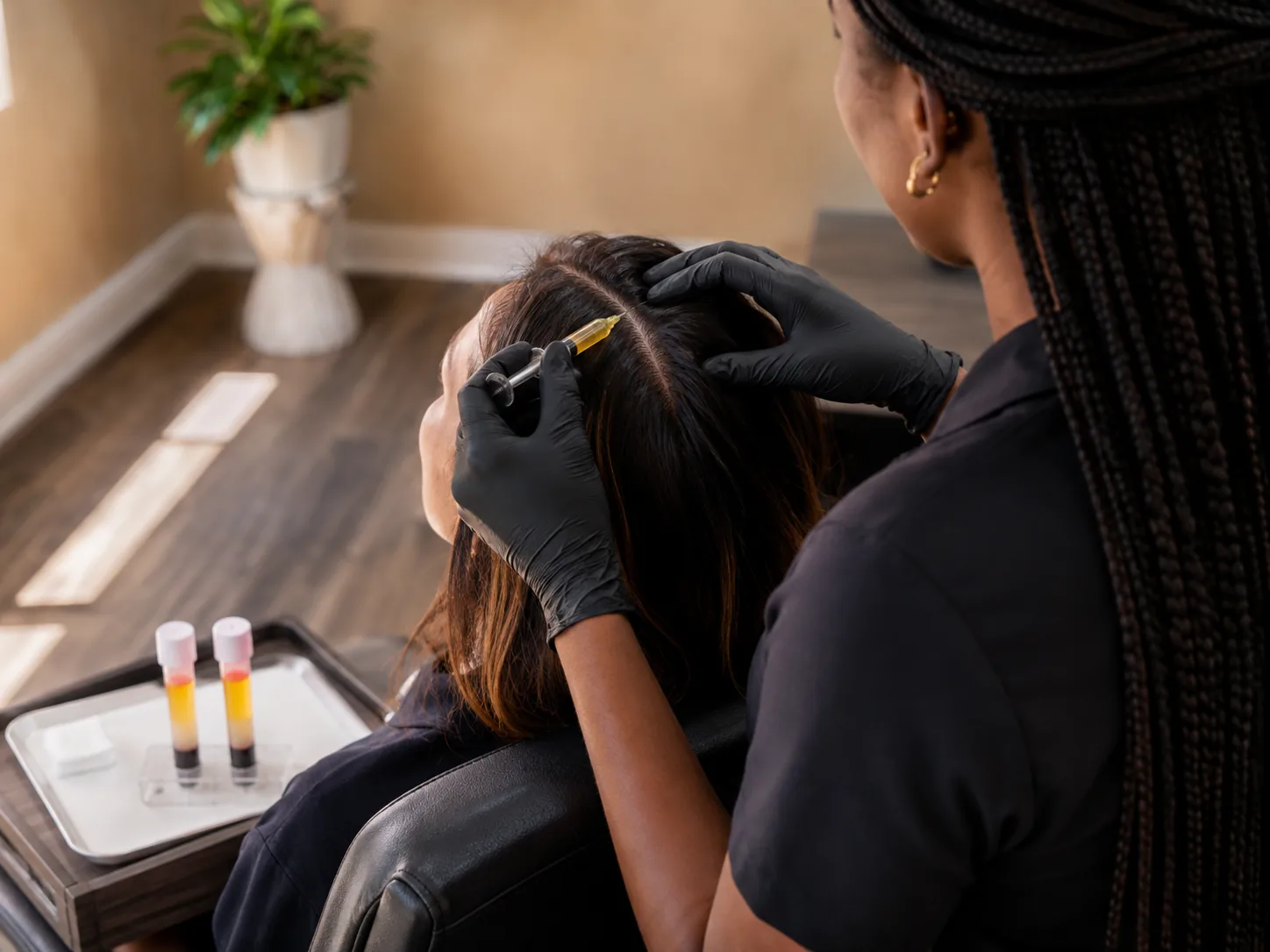
PRP therapy for hair loss uses platelet-rich plasma prepared from a small sample of your own blood and delivered into the scalp to support follicles that are still viable.
A session involves a routine blood draw, processing the sample to concentrate the platelet fraction, and delivering that concentrate across the areas of thinning.
At Nina Ross Atlanta in Sandy Springs, serving all of Metro Atlanta, candidacy is screened before any series is booked, because PRP supports follicles that are still alive and does nothing for follicles that are gone. Trichoscopy at 200x magnification is what shows the difference. Certified trichologists perform every hands-on treatment, and Dr. Nina Ross, ND oversees the protocols as Clinical Director. If PRP is not the right first step for what your scalp shows, we say so.
What it does for you
Hairs that are getting finer visit after visit are usually still alive. PRP gives those follicles concentrated signaling from your own blood, the kind of support a struggling follicle can act on.
You find out whether your follicles can still respond before you pay for a series. That answer comes from your scalp on screen at 200x, never from an assumption about your age or your pattern.
The material delivered into your scalp is prepared from your own blood, drawn the same visit and processed on site.
Images from the same positions each time let you see what changed between sessions, rather than relying on memory in the bathroom mirror.
How it works
A small sample of blood is taken from your arm the same way it would be for routine bloodwork. It takes a couple of minutes and most people find it unremarkable.
The sample is spun so the platelet-rich fraction separates from the rest. That concentrate carries the signaling proteins used in the treatment.
The concentrate is delivered into the scalp across the thinning areas at a set depth, so it reaches the layer where the follicle actually sits.
The scalp is prepared first and comfort measures are used. Most people describe brief pressure and short stinging as each area is treated, with the scalp tender and warm for the rest of the day. You can ask us to pause at any point.
Certified trichologists perform all hands-on treatments. Dr. Nina Ross, ND oversees the protocols as Clinical Director. Everything is handled in-house.
What we see that others miss
Most pages about PRP explain the science. Very few tell you who should not be paying for it, and that is the part that decides whether your money does anything.
The first thing that rules PRP out is follicle viability. At 200x we count how many follicle openings still hold hair against how many sit empty, and how much hair thickness varies within a small area. Wide variation with openings still occupied reads as miniaturization, and that is the picture PRP is for. Smooth areas where the openings themselves are gone read as scarred, and no amount of platelet signaling brings back a follicle that is no longer there. We show you that line on your own scalp.
The second is an unsettled scalp. Redness around the follicle openings, scaling, pustules or an active infection mean the follicle is being asked to grow in conditions it is already losing in. Calming comes first, and PRP comes after, if it is still indicated.
The third is a driver outside the scalp. When the shed is even across the whole head, the more likely cause is internal: thyroid, iron, hormonal shift, medication or recovery from a stress event. The internal side is addressed first or alongside, and we handle that in-house.
The fourth is a mismatch of expectation. PRP supports a growth cycle that runs in months. If you need coverage for an event in a few weeks, PRP is the wrong tool, and we would rather tell you that than sell you a series.
What to expect
Candidacy is decided from your Hair & Body Discovery. Your scalp is read at 200x on screen while you watch, and your written report follows the next day.
Standardized images are captured from set positions so every later session compares against the same starting point.
A small sample is taken from your arm at the start of the session. No fasting or special preparation is needed.
The sample is processed on site while you wait, which takes a few minutes.
A certified trichologist delivers the concentrate across the mapped thinning areas, in a pattern set from your own images.
The scalp is usually tender, warm and a little pink for the rest of the day. You get plain aftercare for washing, styling and heat, written for your hair.
Sessions are spaced to match how scalp tissue recovers and how the growth cycle moves. You get the intended spacing in writing before you start.
New magnified images from the same positions are compared against your baseline, and what they show decides whether we continue, adjust or stop.
What is realistic
PRP works through the growth cycle, and the growth cycle does not hurry. A follicle nudged back toward its growing phase still needs months before the hair it produces is long enough to notice in the mirror.
The usual pattern is that shedding settles first, then early regrowth shows under magnification well before it shows to the eye, then density and texture change later in the series or after it.
How much changes depends on how much viability was there at the start, how long the loss has been running, and whether anything internal is still driving it. Where follicles have scarred, that area does not regrow at any point, and we tell you that before you start.
Results not typical. Individual results will vary.
Ideal for
Smooth, round patches that appear quickly. The follicle usually survives.
Tension-driven loss at the edges and part lines. Often reversible early.
Central centrifugal cicatricial alopecia. Starts at the crown and spreads outward, quietly.
The widening part and the thinner ponytail, explained honestly.
Predictable pattern, variable speed. The earlier you read it, the more you keep.
The hormone behind pattern thinning, and how to tell if it is your driver.
Honest screening
Scarred areas where the follicle openings are gone. Platelet signaling needs a follicle to act on, and we show you on screen where that line falls on your own scalp.
An active scalp infection or an inflamed, scaling scalp. That environment needs calming first.
A whole-head shed pointing to an internal driver. Thyroid, iron, hormonal shift or medication needs addressing alongside the scalp work, and we handle that in-house.
Anyone looking for the appearance of density without viability underneath. If the follicles are not there, we say so and talk through what actually applies.
Safe for textured hair
Loss patterns on textured hair are mapped from your own magnified images, because tension loss along the edges and a hormonal pattern at the crown can sit on the same head and need different treatment density. Delivery near the hairline and edges is approached with the tension history of that area in mind.
Aftercare is written for wash days that may be weekly rather than daily, and we plan sessions around protective styles instead of asking you to take them down without a reason. Relaxers, braids, locs, weaves and heat. Share your full history. It is welcomed, never judged.
One visit. Real answers.
Our promiseYou'll leave actually seeing what's happening, your scalp at 200x, the systems behind it, with your report the next day. If you don't, the $99 is on us.
Fully HSA/FSA eligible. 0% financing for qualified applicants.
Hands-on treatments are performed by certified trichologists, with clinical direction from Dr. Nina Ross, ND, Double Board Certified Trichologist. Everything is handled in-house.
10 years of specialized care · 2,500+ clients seen · All care in-house
Questions, answered
There is some discomfort and we will not pretend otherwise. The scalp is prepared first and comfort measures are used. Most people describe brief pressure and a short stinging as each area is treated, then tenderness and warmth for the rest of the day. Tell us as we go and we will adjust or pause.
That depends on what your scalp shows at 200x and how it responds. You get the intended number and spacing in writing before you start, and progress reviews decide whether we continue, adjust or stop.
Not on the scarred area itself. Where follicle openings are gone, there is nothing for platelet signaling to act on. Where follicles are still present around it, PRP may be considered, and we show you where that border falls.
From what your scalp shows and your history. Both support follicles that are still viable, and we explain which fits your presentation, and why, before recommending either.
Follicle viability at 200x, whether the scalp is settled enough to treat, and whether an internal driver is likely. Those three answers decide whether PRP is the right first step.
You are not committing to a series today. The first step is smaller: finding out whether your follicles can still answer, and leaving with that in writing either way. Serving all of Metro Atlanta.
Nina Ross Atlanta, 8735 Dunwoody Place, Suite 290, Sandy Springs, GA 30350. Monday to Saturday, 10:00 AM to 3:30 PM.