 03
03
Alopecia Areata
Smooth, round patches that appear quickly. The follicle usually survives.
Home / Treatments / Regenerative / Exosome Therapy
Regenerative · treatment 03 of 8
Knowing whether the newest option is the right one for you.
 Clinically reviewed by Dr. Nina Ross, NDServing all of Metro Atlanta
Exosome therapy for hair loss delivers concentrated growth signaling material into the scalp to support follicles that are still viable.
Exosomes are tiny vesicles that cells use to send signals to one another, and in a hair treatment they deliver that signaling directly to the follicle environment.
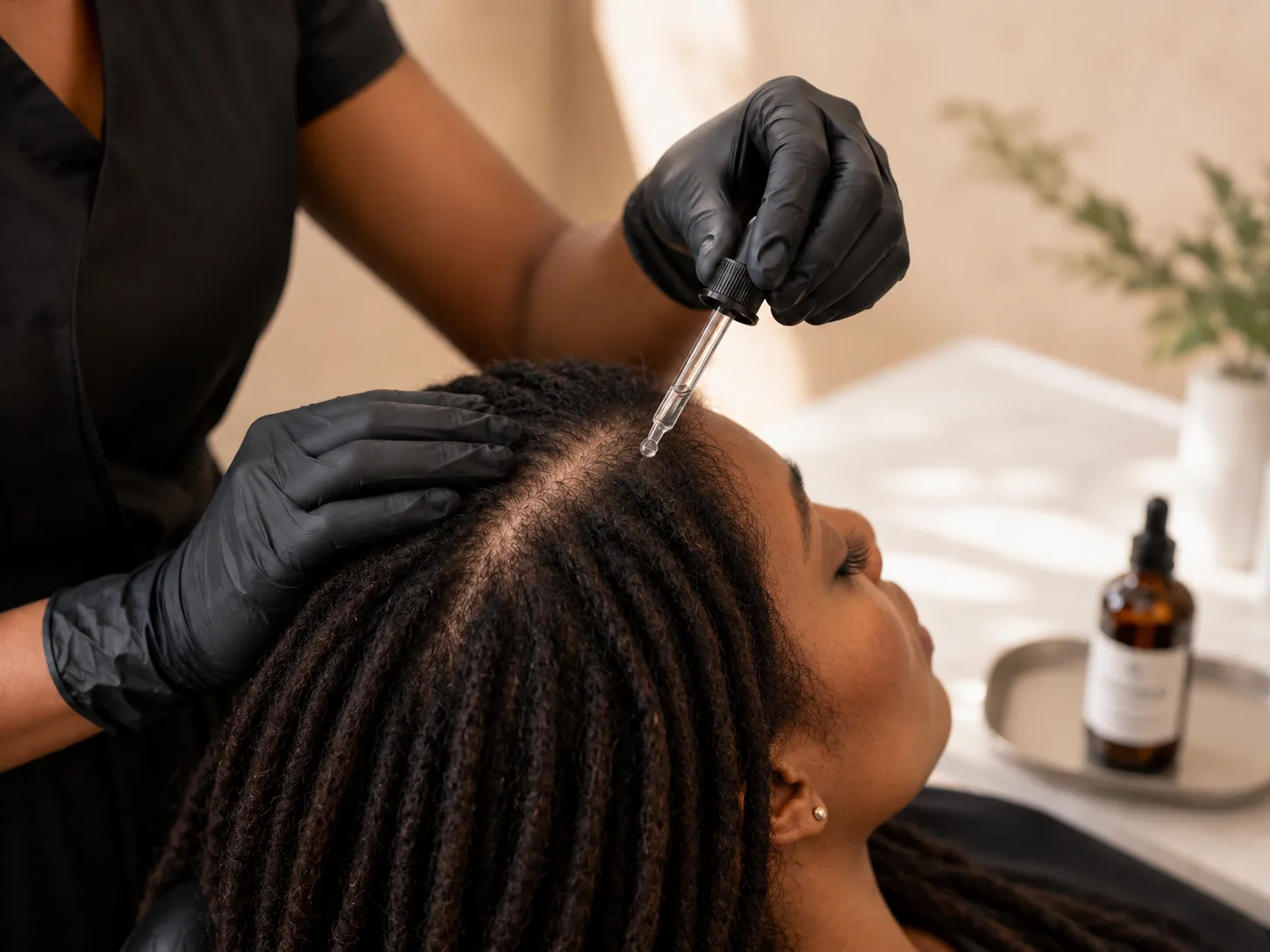
A visit involves preparing the scalp, delivering the material across mapped areas of thinning, and short aftercare, with the whole appointment usually running under an hour. It tends to be considered for diffuse thinning, patchy loss that has settled, and cases where a stronger signal is wanted than other options have delivered. At Nina Ross Atlanta in Sandy Springs, serving all of Metro Atlanta, candidacy is decided after seeing your scalp at 200x magnification, because signaling only helps a follicle that is still there. Certified trichologists perform every hands-on treatment and Dr. Nina Ross, ND oversees protocols as Clinical Director.
What it does for you
Where follicles are miniaturizing, the limiting factor is often the signaling environment around them. Exosome therapy is aimed squarely at that environment.
You find out before you pay for a series whether exosomes fit your presentation, or whether PRP or something else is the better use of your money. That answer comes from your own scalp on screen.
There is no blood draw and no waiting for processing, so the appointment is short and the aftercare is simple.
The material reaches the follicle layer. It supports follicles that are still alive, does nothing for follicles that are gone, and we tell you which is which.
How it works
Nothing is delivered before we have looked at your scalp at 200x and know where the follicles are still producing. That read sets the map for where the material goes and how densely.
The scalp is cleaned and prepared, and comfort measures are used. Microchanneling is often used alongside delivery so the material reaches the follicle layer.
A certified trichologist delivers the material across the mapped areas, working from your own images.
Most people describe brief stinging and pressure as each area is worked, and warmth or tenderness for the rest of the day. You can ask us to pause at any point.
The scalp stays untouched for the rest of the day, then normal washing resumes on the schedule we give you, written for your hair.
Certified trichologists perform all hands-on treatments. Dr. Nina Ross, ND oversees the protocols as Clinical Director. Everything is handled in-house.
What we see that others miss
Both deliver signaling into the scalp, and both need a living follicle to act on. The choice is made from what your scalp shows.
What the trichoscopy shows. When openings are still occupied and hair thickness varies widely within a small area, that is active miniaturization and either option is on the table. When the scalp also reads inflamed, we calm it first. Where openings are gone and the surface is smooth, neither applies and we say so.
Pattern of loss. Diffuse thinning across the whole head usually points toward exosomes, because the material is consistent across a large map. A defined area such as a crown or a receding front is well served by PRP, which can be worked more heavily into one zone.
Prior response. If a PRP series showed little change in your own comparison images while follicles still read viable, that is a common reason to move to exosomes. Someone who responded to PRP and simply stopped usually restarts what worked.
Blood and health context. PRP depends on your own platelet fraction, so anemia, certain medications and some blood conditions change what a draw can deliver. Exosomes avoid that dependency, and suit anyone who does not want a draw.
Cost against likely benefit. Exosomes cost more per session. Where your scalp suggests either would respond, we say so plainly and let you choose.
What to expect
Candidacy is decided from your Hair & Body Discovery. Your scalp is read at 200x on screen while you watch, and your written report follows the next day.
Standardized images are captured from set positions so every later review compares against the same starting point.
The scalp is prepared, a certified trichologist delivers the material across the mapped areas, and you are out inside the hour.
The scalp is usually warm and a little tender. You leave with plain aftercare covering washing, styling and heat.
Spacing is set to match how scalp tissue recovers and how the growth cycle moves. You get it in writing before you start.
New magnified images from the same positions are compared against your baseline, and what they show decides whether we continue, adjust or stop.
What is realistic
Exosome therapy works through the growth cycle, and the growth cycle sets the pace. Nothing visible happens in the first weeks.
The usual pattern is that shedding settles first, then early regrowth appears under magnification well before it shows in the mirror, then density and texture change later.
How much changes depends on how much viability was there at the start, how long the loss has been running, and whether anything internal is still driving it. Where follicles have scarred, that area does not regrow at any point, and we tell you before you start.
Results not typical. Individual results will vary.
Ideal for
Smooth, round patches that appear quickly. The follicle usually survives.
The widening part and the thinner ponytail, explained honestly.
Sudden diffuse shedding, usually about three months after a trigger.
Honest screening
Scarred areas where the follicle openings are gone. Signaling needs a follicle to act on, and we show you on screen where that line falls.
An inflamed, scaling or infected scalp. That environment needs calming first.
A whole-head shed pointing to an internal driver. Thyroid, iron, hormonal shift or medication needs addressing alongside the scalp work, and we handle that in-house.
Anyone choosing exosomes only because they are the newest option. If your findings point to PRP or something simpler, that is what we recommend.
Safe for textured hair
Loss patterns on textured hair are mapped from your own magnified images, because tension loss along the edges and a hormonal pattern at the crown can sit on the same head. Delivery near the hairline accounts for its tension history, and at the crown it accounts for how the hair sits and parts.
Aftercare is written for wash days that may be weekly, for oils and butters, wraps and bonnets. We plan sessions around protective styles. Relaxers, braids, locs, weaves and heat. Share your full history. It is welcomed, never judged.
One visit. Real answers.
Our promiseYou'll leave actually seeing what's happening, your scalp at 200x, the systems behind it, with your report the next day. If you don't, the $99 is on us.
Fully HSA/FSA eligible. 0% financing for qualified applicants.
Hands-on treatments are performed by certified trichologists, with clinical direction from Dr. Nina Ross, ND, Double Board Certified Trichologist. Everything is handled in-house.
10 years of specialized care · 2,500+ clients seen · All care in-house
Questions, answered
PRP is prepared from your own blood in the room, so what it delivers depends on your platelet fraction that day. Exosome therapy uses prepared signaling material, so there is no draw and no waiting. Both need a living follicle to act on, and which one we recommend comes from your scalp, your pattern and how you have responded before.
Newer means newer. What decides whether exosomes are right for you is what your scalp shows at 200x, and sometimes PRP or something simpler is the better fit.
That depends on what your scalp shows and how it responds. If a series is indicated, you get the number and spacing in writing before you start.
Anyone with scarred areas where openings are gone, an inflamed or infected scalp that needs calming first, or a whole-head shed driven by something internal that has not been addressed.
Follicle viability at 200x, whether the scalp is settled, your pattern of loss and any internal drivers. Those answers decide between exosomes, PRP or a different first step.
You are not committing to a series today, and you do not have to work out on your own which option is right. The first step is smaller: finding out what your scalp can still do, and leaving with that in writing. Serving all of Metro Atlanta.
Nina Ross Atlanta, 8735 Dunwoody Place, Suite 290, Sandy Springs, GA 30350. Monday to Saturday, 10:00 AM to 3:30 PM.