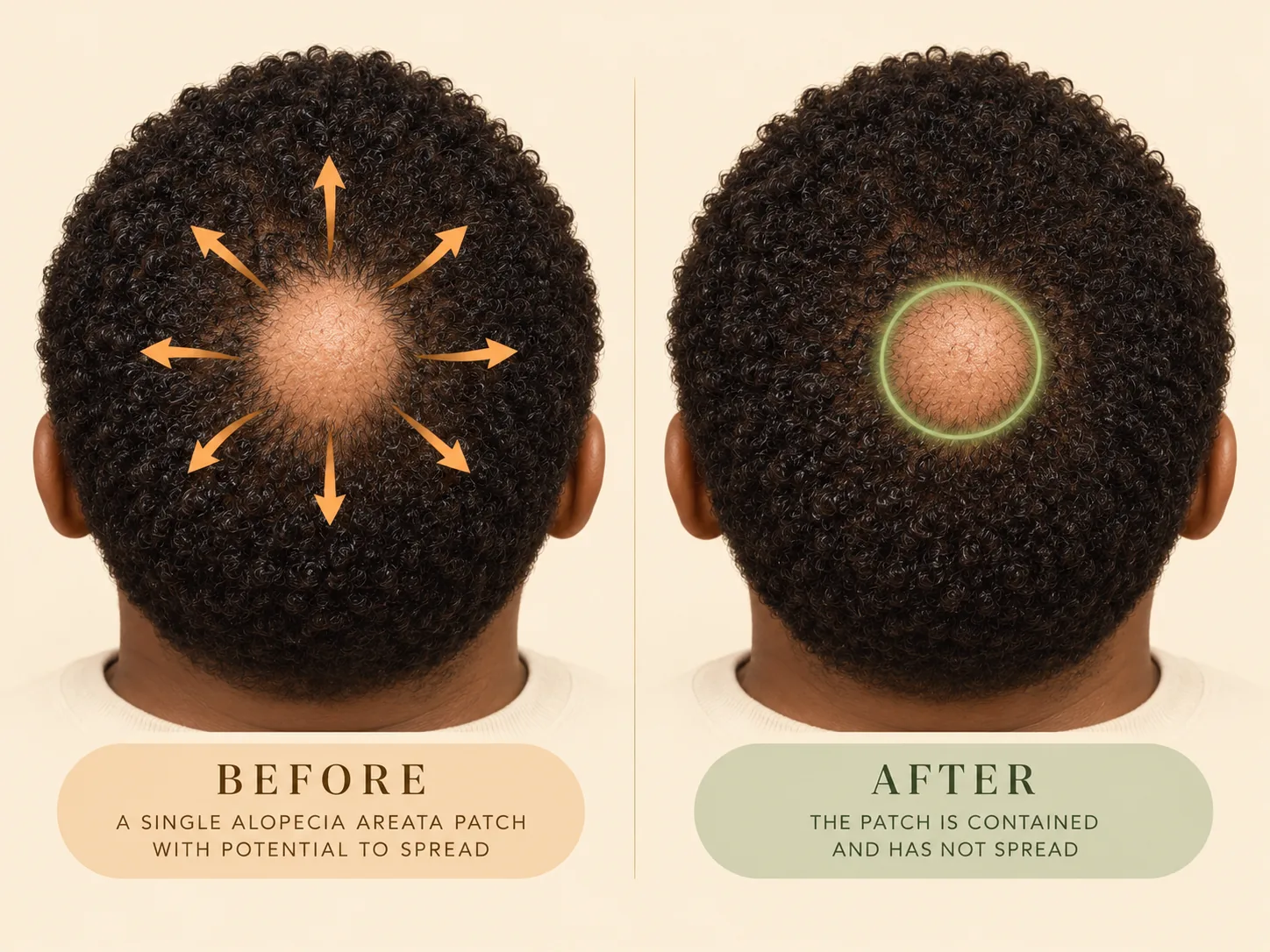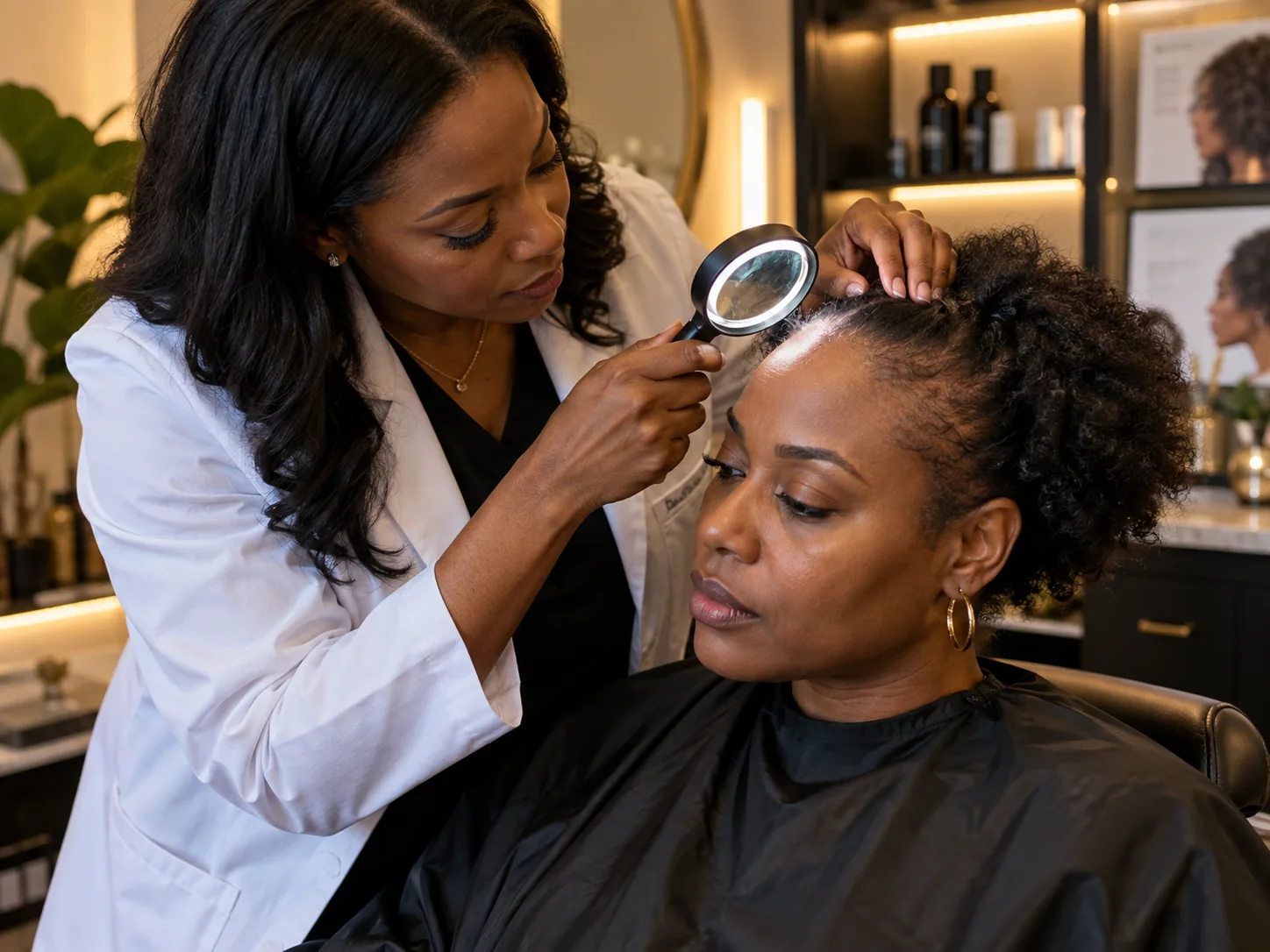

Sometimes Yes, Sometimes Partly, And The Read Tells You Which
If you have been asking whether it is too late for your edges, you deserve a real answer from someone who can actually see what is left.
If You Have Said Any Of These, Read The Next Part
Long-standing tension can replace the follicle with fibrous tissue. When that happens, the follicular opening closes and the surface smooths over. Scarred follicles do not regrow. There is no product, injection or protocol that brings back a follicle that is no longer there, and anyone who tells you otherwise is selling you a year you cannot get back.
What Follicular Scarring Means
Manageable care still exists at that stage. The border beside a scarred band usually still holds viable follicles, and protecting those is the difference between a line that holds and a line that keeps moving. Full regrowth of the scarred band may not happen, and we will tell you that on the first visit rather than the sixth.
What We Look For At 200x, Stage By Stage
A hairline can hold more than one stage at once. One section may still show follicular openings and small hairs, while another looks smoother. We examine the margin section by section rather than forcing the whole area into one label.
The $99 Discovery Tells You If It's Reversible
The Discovery is designed to replace a mirror-based guess with a magnified baseline. You watch as we move along the affected area, document what remains, and explain which sections may still have recovery potential and which may need a management goal.
What The Work Looks Like At Each Stage
Early and advanced areas require different work. Where follicles remain, reducing tension and supporting recovery are central. Where scarring has closed the openings, the honest goal changes, and we will not sell regrowth where the scalp does not support that promise.
What 200x magnification helps us separate
| What the area shows | What it may mean for the conversation |
|---|---|
| Follicular openings are visible | There may still be an opportunity to support recovery |
| Miniaturized hairs remain | The follicle is still producing hair, even if the strand is weaker |
| Openings appear closed or scarred | The goal may need to shift from regrowth to management |
| A mixed hairline | Different sections may need different expectations and care |
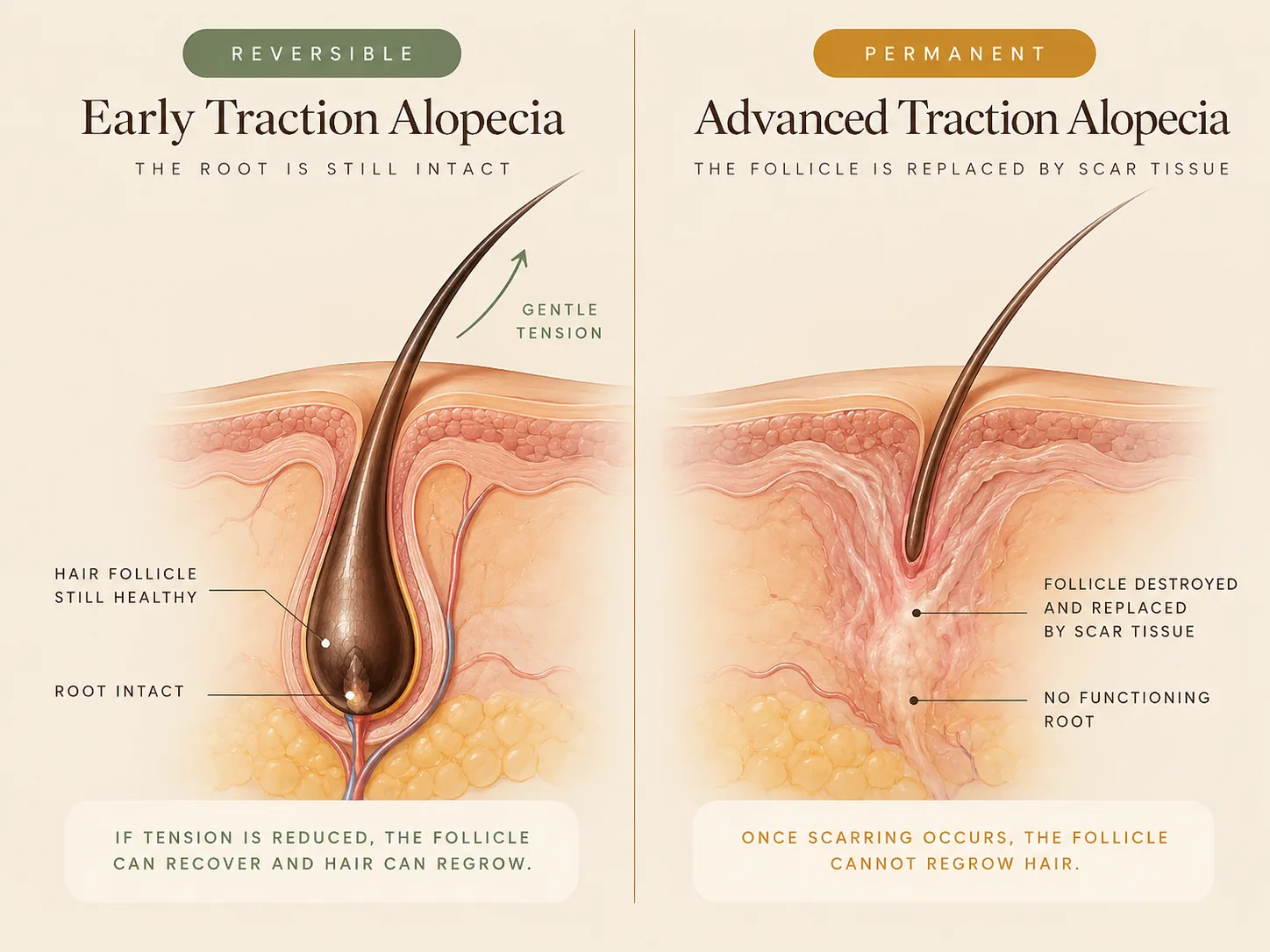
This is why a single answer for the entire hairline can be misleading. One area may still have openings and small hairs while another looks smooth. We map what is actually present before talking about what may be possible.
The stage changes the work
- Early stressTension is reduced and the scalp is given room to recover.
- Miniaturized hairs remainThe plan focuses on supporting follicles that are still producing hair.
- Mixed areasExpectations and care are separated by what each section shows.
- Advanced scarringThe conversation becomes honest management rather than a promise of full regrowth.
The purpose of staging is not to frighten you. It is to stop wasting time on a plan designed for a different condition or a different point in the process.
What your styling history adds
We ask where tension has been concentrated, how long the style was worn, whether the same areas were repeatedly stressed, and when tenderness or bumps appeared. That history helps the magnified picture make sense without turning the appointment into a lecture about how you wear your hair.
- Styles that repeatedly pulled the same area
- Tenderness, bumps, or soreness around the hairline
- When the thinning first became visible
- Whether the area has continued to change
- Products or treatments already tried
An honest answer is still a useful answer
We will tell you what the scalp supports. Reversible and manageable are different outcomes, and both deserve a clear plan. Results not typical. Individual results will vary.
If openings and miniaturized hairs remain, there may be meaningful work to do. If scarring has closed an area, knowing that now protects you from spending more time and money on claims the scalp cannot support.
Clarity is not giving up. It is the point where care becomes more precise, expectations become kinder, and the next decision finally fits the stage you are in.
Not sure this is you? See your scalp at 200x.
Book My $99 DiscoveryFrequently asked questions
Can traction alopecia be reversed?
Early traction alopecia is often reversible when follicles remain present and the pulling load is removed. Advanced areas with scarring may not fully regrow. Results not typical. Individual results will vary.
How can you tell whether follicles remain?
A 200x scalp read can show whether follicular openings and miniaturized hairs remain along the affected margin. A smooth appearance in the mirror is not enough to stage every section accurately.
Can one hairline have more than one stage?
Yes. One section may still show openings and small hairs while another appears closed or scarred. That mixed picture is why expectations and care may differ from one area to the next.
What should I bring to a traction alopecia evaluation?
Bring the styling timeline, where tension was repeatedly concentrated, when tenderness or bumps appeared, how the area has changed, and what you have already tried. That context helps the magnified picture make sense.

Written and reviewed by
Double Board Certified Trichologist. PhD in Functional Drugless Medicine. Master Cosmetologist. Founder and Clinical Director of Nina Ross Atlanta, with 10 years of specialized care and 2,500+ clients seen.